

Does the Trump Administration's H20 Decision Hold Water?

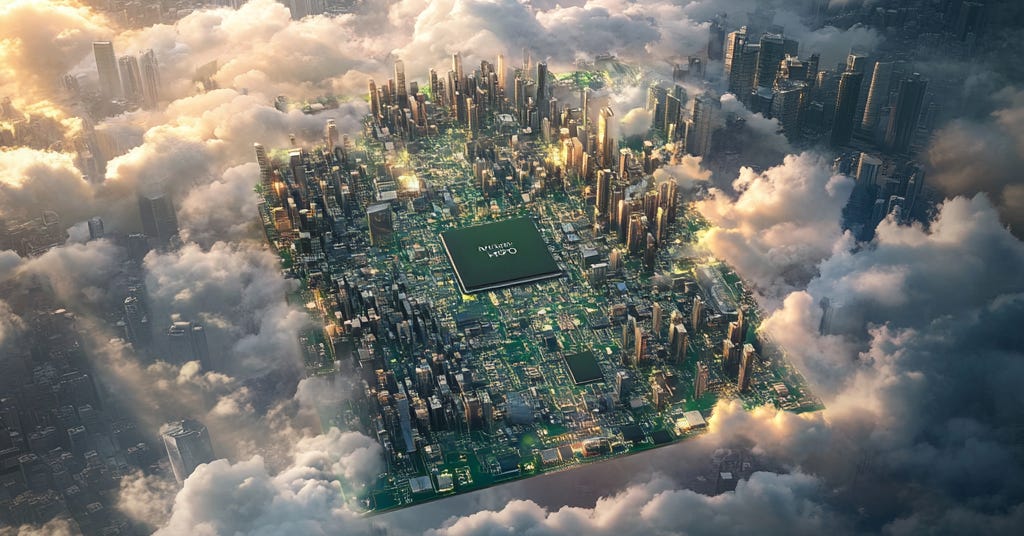
The Trump administration’s decision to approve the sale of NVIDIA's H20 chip to China is clear in its departure from its stated views on U.S.-China AI competition but less clear about the strategic AI goals it’s trying to accomplish.1
While Commerce Secretary Howard Lutnick has defended the move by emphasizing that the U.S. is only licensing NVIDIA’s “fourth-best” chip and tying the decision directly to a rare earth trade agreement, others, including many in Congress, view it as a troubling and potentially dangerous concession that jeopardizes American national security.
The reality of the decision is complicated. Is it a clever strategic tradeoff, a concession wrapped in strategic clothing, or simply an effort to support a company’s bottom line dressed up as national security?
The decision may represent a tactical concession intended to manage near-term pressure points, preserve leverage in trade talks, and delay Chinese adoption of indigenous alternatives. Alternatively, it may reflect something less coherent, and perhaps a reactive shift that sacrifices long-term strategic clarity for short-term economic and diplomatic benefits. Either way, the consequences stretch well beyond rare earths or chip inventory and go to the core of America’s evolving AI strategy.
How Trump Decided to Pour H20s Back into China
As early as January, the Trump administration was discussing new restrictions on the export of NVIDIA’s H20 AI chip to China. In mid-April — after some hesitation — the administration pulled the trigger on the restrictions. NVIDIA subsequently reported a $5.5 billion charge due to canceled orders in China.
Then came a pivot. As part of a broader (and at first secret) trade deal reached in London some weeks ago, China agreed to lift restrictions on rare earth magnet exports. In return, the U.S. agreed to license H20 shipments to Chinese customers. Lutnick confirmed that the decision to license the export of H20s to China was directly tied to that agreement: “We put that in the trade deal with the magnets.”
The move revived a key NVIDIA revenue stream (even before the announcement, the company had become the first four trillion dollar company by market cap in history) and sent Chinese firms scrambling to place orders. But the approval of H20 chip sales to China also contradicted prior recommendations from the House Select Committee on Competition with China, which had explicitly called for the H20 to be added to the export control list (in large part because of the committee’s view that the H20 was used to train DeepSeek’s models and potentially increased national security risks).2
Dissecting the Motivations: Strategy, Transaction, or Retreat?
1. A Strategic Tradeoff?
One interpretation of the H20 decision is that it reflects a deliberate national security tradeoff, not a capitulation. The Trump administration may have judged that the risks of allowing China access to a downgraded AI chip were outweighed by the urgency of restoring U.S. access to rare earth magnets. These inputs are essential to defense platforms, EVs, and advanced manufacturing. Under this view, licensing the H20 was less about appeasement or commercial accommodation than about stack-ranking national security priorities.
Rare earths are a real chokepoint, and China’s willingness to weaponize them underscores the mutual strategic dependencies between the two countries. By contrast, the H20, which was deliberately engineered to sit below thresholds for frontier model training, may have been seen as a manageable exposure. This suggests a comfort with controlled risk, allowing limited U.S. tech to flow to China in exchange for bolstering security in other sectors.
2. AI Strategy Adrift?
Even if the H20 deal represents a defensible tradeoff between competing security concerns, it also risks signaling a broader erosion of strategic clarity. Export controls are supposed to draw bright lines, especially in contexts like the strategic tech competition with China. They’re expressions of what the U.S. considers off-limits in its tech relationship with China.
By tying access to these controls to a commodity-for-chip swap, the administration risks reframing them as flexible instruments of diplomacy rather than principled tools of containment.
That’s a very different posture. Controls become bargaining chips — yes, you can have H20s if you ease rare earth restrictions; maybe next time it's beef tariffs or auto imports — instead of guardrails protecting U.S. strategic advantage.
That shift raises tough questions. If H20 chips can be licensed under the right geopolitical conditions, where is the line? What else is negotiable? Flexibility may serve near-term interests, but over time it risks undercutting the credibility of U.S. export policy. Allies who’ve harmonized their controls with the U.S. may wonder if U.S. rules are fixed or situational. Adversaries may conclude that even “red lines” are just opening bids.
To be fair, we don’t know all the details of the deal, and the green light for the H20 chips is not a divergence from the Biden administration, which also appeared comfortable with H20 exports to China despite its aggressive moves on AI diffusion.
But in the absence of more transparency, this looks like strategic drift. A regime built to limit the diffusion of AI-enabling compute risks becoming reactive, discretionary, and transactional. The long-term cost is a loss of coherence.
3. A Return to Integration Over Isolation?
There’s also a deeper philosophy at work that’s familiar in Silicon Valley. Rather than wall China off, many in the tech world have long argued that it’s smarter to keep China tethered to the U.S. tech stack. The idea is that even downgraded U.S. tools create dependence, and dependence creates leverage.
This worldview isn’t new — it’s very 2010s — but it’s having a bit of a revival. Both Jensen Huang and David Sacks (the White House AI czar) have voiced versions of this logic. Sacks, for example, recently warned: “If you give the whole Chinese market to Huawei, it’s a huge subsidy for their R&D. It basically forces Chinese companies that might be willing to use the H20 to use the Huawei chip.” The suggestion is that keeping China reliant on American tech, even if limited, is preferable to forcing it to go all-in on homegrown alternatives.
There’s a lot to admire in this logic. If you still believe in the gravitational pull of the American tech ecosystem, it’s the right play to keep China inside the stack, even if only partially. But in 2025, that vision is harder to sustain. The global trend is toward tech — and more specifically, AI — sovereignty. Trump 2.0 is reinforcing that shift. So are Europe, India, the Gulf states, and others. The age of seamless global platforms is giving way to more discrete tech architectures.
Even Huang has acknowledged the trend, highlighting that export controls are pushing China to build its own stack: “Export controls gave [China] the energy to go build something of their own.” Integration remains the ideal, but it simply looks less and less like reality. He’s also been a major champion of AI sovereignty.
4. A Concession to Industry?
Finally, it’s worth noting the role of industry in shaping this outcome. NVIDIA was facing billions in stranded inventory. Its lobbying was public and persistent. Allowing H20 exports provided a fast path to revenue recovery, and it may have been reframed internally as a necessary concession to stabilize a strategically critical U.S. firm (not its market cap but its competitive product position vis-a-via Chinese competitors).
Domestic politics likely mattered too. While Republicans in Congress had pushed for tighter enforcement, the rare earths deal — and NVIDIA’s pledge to invest in U.S. AI infrastructure — may have made the decision easier to accept and justify for the administration.3
Impact: Strategic Fog or Strategic Flexibility?
The H20 decision does not necessarily mark a shift into a new “improvisational” phase of U.S. export control strategy, though there definitely seems to be some of that (there always is).. Instead, I think more than anything else it surfaces an unresolved debate within the U.S. government (and the broader policy community) about what success in the U.S.–China AI competition actually looks like. And this lack of consensus leads to improv.
Some in the administration, like Secretary Lutnick, view chip controls as tools of leverage — flexible and transactional, meant to be adjusted in response to broader geopolitical bargaining. (This approach is, in my view, strategically constrained and not focused enough on the long-term challenges posed by AI.)
Others, like Sacks, frame the decision as a return to integration over isolation: a way to keep China tethered to the U.S. tech stack and slow Huawei’s ascent. (I’m sympathetic to this perspective — it aligns with my own — but I also think it’s increasingly out of step with the geopolitical realities of 2025, which won’t change without more serious and sustained U.S. engagement.)
Still others, particularly in Congress, argue that concessions like this one undermine the tech containment system the U.S. has spent years constructing. (There’s some truth to this view, though it risks becoming overly rigid and disconnected from the global diffusion challenge.)
This divergence reflects a broader and deeper uncertainty about how the U.S. defines “winning” in the AI race. Is it about:
Denying China access to AI compute?
Preserving U.S. dominance in the AI supply chain?
Ensuring allies build on American platforms?
Enabling the global diffusion of U.S. AI technologies under guardrails that protect national security and democratic values?
In this context, the H20 deal may bring short-term tactical gains (e.g., restoring access to rare earths, preserving the U.S. presence in China’s AI stack). But it comes at the cost of strategic clarity. It blurs the boundary between controls as a tool of containment and controls as a lever of negotiation. It makes it harder for allies to interpret U.S. policy and easier for adversaries to game it.
Without a clearly articulated vision for what the U.S. is trying to achieve with export controls and AI governance, decisions like this one risk becoming reactive, inconsistent, and vulnerable to short-term pressures.
Conclusion: A Moment for Strategy, Not Improvisation
The H20 decision (at least to me) more than anything else suggests a lack of strategic consensus on how the U.S. should manage AI competition with China.
It’s not enough to improvise from deal to deal (again, perhaps reflecting a lack of consensus). What the moment calls for is a coherent, durable strategy that enables the responsible international diffusion of American AI technology (and in ways that reinforce U.S. leadership, minimize national security risk, and prevent advanced capabilities from empowering authoritarian rivals).
That strategy needs to be built and exist on more than tactical exceptions. It requires principled boundaries and clear goals that focus intensely on but also extend beyond blocking China today, broadening the aperture to shape the global future of AI.
Conflict of Interest Disclosure: The views I express in this essay are my own. While I maintain professional affiliations and advisory roles with various organizations, I don’t receive compensation or direction from them (or from any other entities) for the views expressed in my essays, unless explicitly stated otherwise in a particular piece. In some cases, I may receive an honorarium from the publisher as compensation for contributing the essay itself.
Also, I know the H20 is H plus the number 20 and not H₂O, but I just couldn’t help the water puns. The alternative was to do a bunch of chip-related puns (“All chips and no salsa” came to mind.) Apologies to those I’ve offended.
Most of what I’ve read about DeepSeek’s models suggests that the H20 wasn’t used for training, so it’s not clear to me why H20s became such a focus for congressional China hawks and the second Trump administration in its early days. If you are aware of good sources showing the risks of H20 use by Chinese entities, please send them along.
[UPDATE: I’m prone to typos and this footnote was a really good example of that, so I’ve corrected a couple. Also, thank you to two friends who point out that (1) there are definitely good sources that say H20s have been used by DS for training (e.g., SemiAnalysis: “We believe DeepSeek…have orders for many more H20’s, with Nvidia having produced over 1 million of the China specific GPU in the last 9 months. These GPUs are shared between High-Flyer and DeepSeek and geographically distributed to an extent. They are used for trading, inference, training, and research.”) and other sources that explicitly state that H20s are used for inference and implicitly suggest that they’re used for training (see, e.g., this Information article). Perhaps more importantly, as one friend points out, the lines between training and inference are blurring, suggesting that we may need to move away from treating them as neatly separable stages from a policy perspective.]
As a quick aside, the H20 licensing decision applies to physical exports by NVIDIA but doesn’t seem to apply to U.S. cloud providers offering compute services to Chinese customers. BIS guidance continues to treat remote access to AI infrastructure for model training as a regulated export, particularly for users in China. I plan to look into this, but at a high level, it seems like a bit of an inconsistency.